Penn State Field School at YBRA
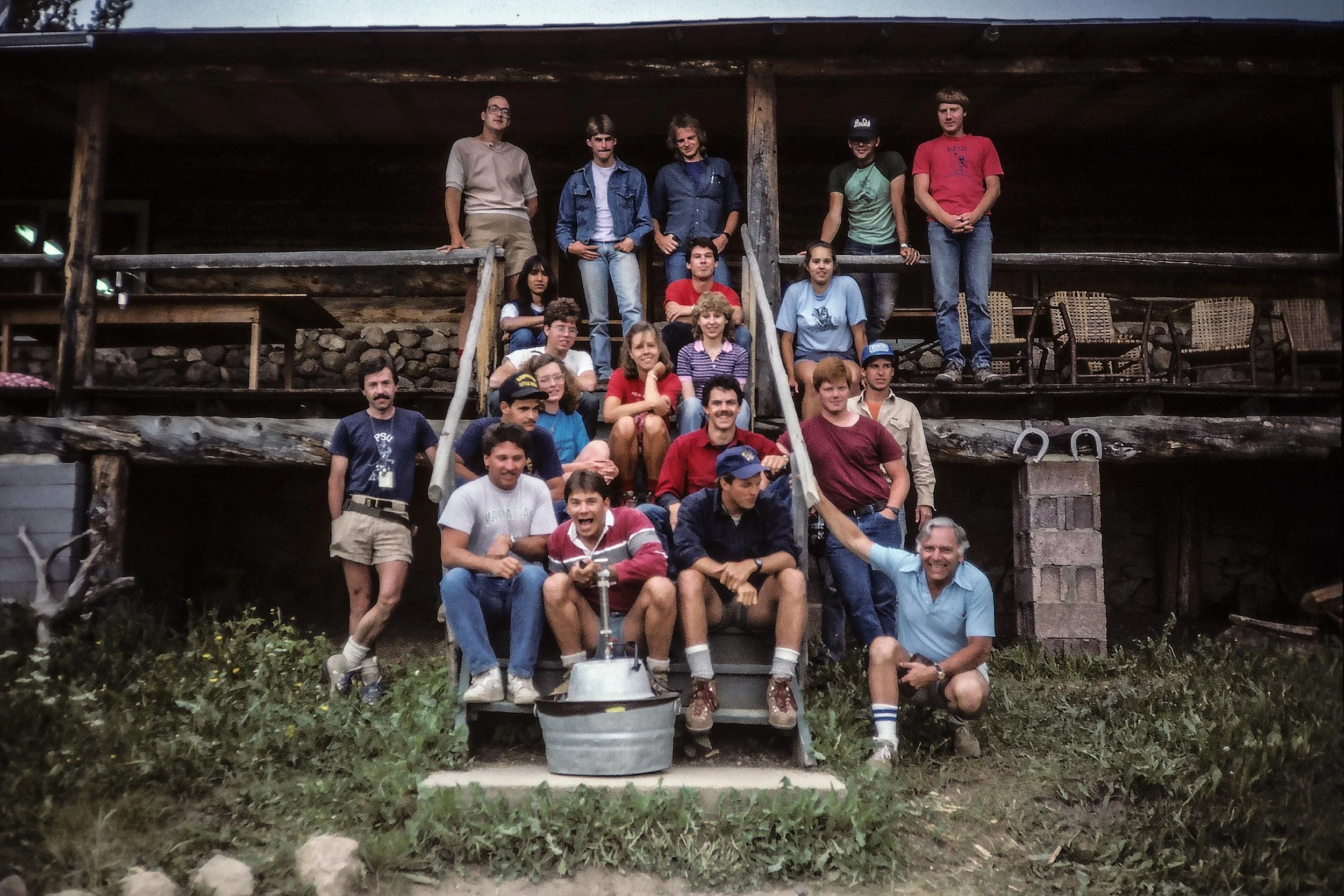
1986 Penn State field school class with Duff Gold (front right) and Slingerland (left).
A History of the Penn State Geosciences Field School at YBRA
By Rudy Slingerland
Professor Emeritus of Geosciences
Department of Geosciences
Pennsylvania State University
This document summarizes the relationship between the Yellowstone Bighorn Research Association (YBRA) and Penn State’s Geosciences Field School. Geological field training has been a requirement for graduation in the geosciences at Penn State since 1919. Initially, field training was conducted in the folded Appalachians, but changing faculty interests and the advantages of better rock exposure prompted a change in venue. Penn State students and professors first came to YBRA in 1963, stopping over for a few days on their way to Lima, Montana where PSU Professor Rob Scholten had an ongoing mapping program. A student on the trip, Jerry Bartholomew, would graduate with a B.S. in Geology from Penn State in 1964 and many years later would spend a decade teaching at YBRA.
In 1965 Penn State’s camp moved from Lima to YBRA at the instigation of two new Penn State field school instructors—Russ Dutcher and Barry Voight. They used the YBRA facilities to teach 12 PSU students for five weeks from July 5 to August 7.
In 1966 Penn State’s field school returned to YBRA, this time with Russ Dutcher and Duff Gold as instructors. Because of a small number of students, the Princeton-YBRA Field School was combined with the Penn State Field School into a single curriculum of instruction that included Elk Basin, the Beartooth Front, Stillwater, Little Bear Creek, Rosebud, and a Yellowstone trip. A Penn State student, Dave Owens, remembers that "it was all one class -- we all piled into the same vans together, went on the same itinerary together, did the same exercises together.” Another student, Peter Tillman, writes: “I can recall students from Princeton, Penn State, Dartmouth, William & Mary, and one Rice guy (me) in the class.”
From 1967 to 1970 Penn State ran its own five-week field school out of YBRA with Russ Dutcher and Duff Gold assisted by various PSU faculty. Each year about 15 to 20 students conducted exercises at Line Creek, Elk Basin, Clark's Fork, Rattlesnake Mountain, and the Beartooth Front. Later, a one-day exercise was added to map glacial deposits on Rosebud Creek.
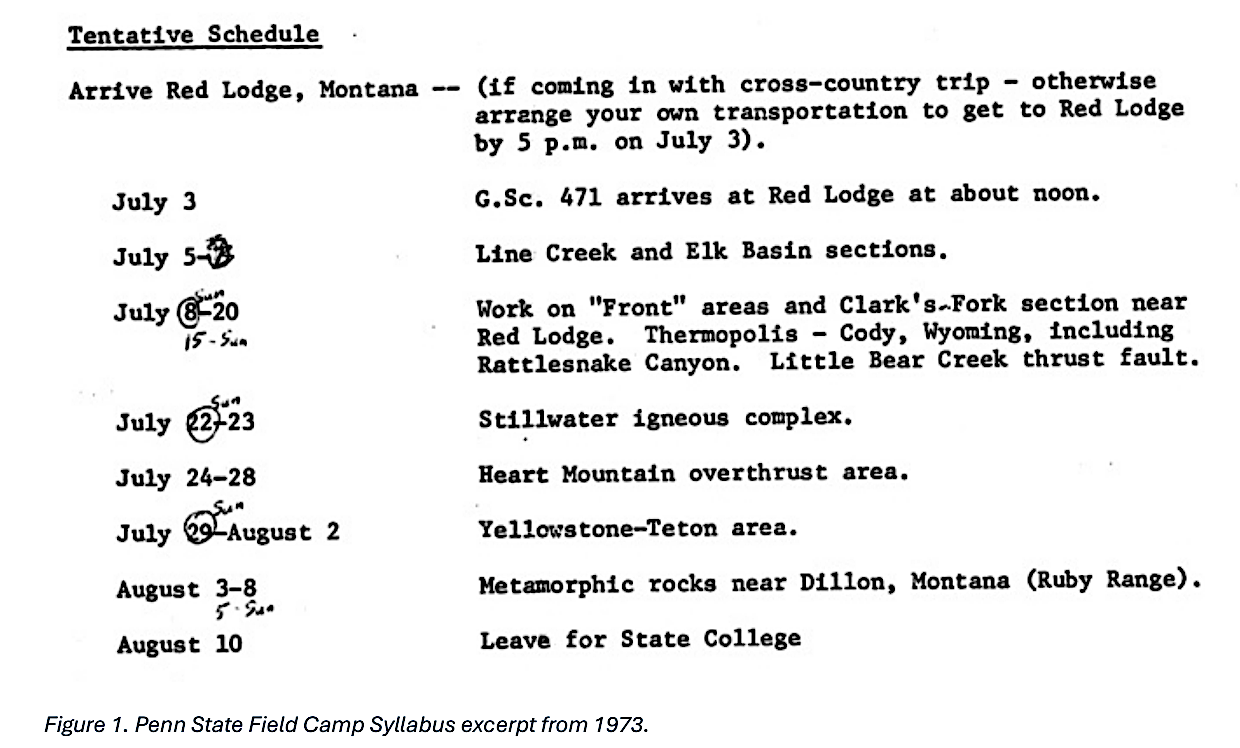
The 1971 to 1973 years saw the departure of Russ Dutcher from Penn State. Duff Gold took over as our Field School leader, assisted by various PSU faculty of the era, including Barry Voight, Art (Boettcher) Montana, and Derrill Kerrick. We still stayed at YBRA for five weeks, and in fact, YBRA meeting minutes of 11/2/71 note that, “D. Gold reported that Penn State University has decided that the YBRA facilities will be the base for their field course operation on a continuing basis, and in addition that PSU would make a financial commitment to YBRA." The syllabus for 1973 is typical of this period (Fig. 1).
By 1974 Penn State’s field school had grown to 27 students and was crowding out the YBRA Penn/Princeton program. Additionally, Penn State faculty (some combination of Duff Gold, Rob Scholten, Art Rose, Wayne Burnham, Art (Boettcher) Montana, Barry Voight, and Derrill Kerrick) were interested in geologic problems in other areas. Consequently, from 1974 to 1976 Penn state reduced its time at YBRA by also staying at Little Sheep Creek Campground, Lima, Montana; Western Montana College, Dillon, and Northwest Community College in Powell. In 1975, PSU’s 35 students were split between YBRA and Northwest Community College. By 1976 our field school had grown to 51 students and overcrowding made it clear YBRA could no longer accommodate us.
In 1977 PSU moved its entire field school to the Wasatch Range, staying in Alta or at the University of Utah in Salt Lake City while working on Quaternary geology and the Alta overthrust, stock, and skarns. In 1981 our field school returned to the Elk Basin Exercise, but because of high student numbers stayed at Northwest Community College, Powell, Wyoming through 1985.
Penn State returned to YBRA in 1986 with 19 students and Tom Gardner, Duff Gold, Dave Eggler, and Rudy Slingerland as instructors. We spent a week at Elk Basin and Rosebud Creek before decamping to the Salt Lake area for the remaining exercises. This pattern of an early June, 7-9 day residence at YBRA would persist for 12 years under the guidance of Penn State faculty members Duff Gold and Dave Eggler. Student numbers during this interval ranged between 10 and 20 per year.
In 1998 Penn State brought 17 students to YBRA. Instructors Duff Gold and Dave Eggler were joined by Don Fisher who would become the new field school director upon Duff’s retirement. YBRA’s “Fire Pit at the Point” was constructed in June 1998 by Penn State field school students and alumni in honor of Duff’s long association with YBRA.
In 1999 Penn State undergraduate majors were so few that our field school was canceled. The four or so students needing it to graduate were advised to try YBRA and other camps.
From 2000 until present Penn State continued its association with YBRA, bringing its students for both the Elk Basin and Rosebud exercises until 2005, and then for just the Elk Basin Exercise. Faculty have included some combination of Rudy Slingerland, Don Fisher, Dave Eggler, Eric Kirby, Terry Engelder, Dave Bice Maureen Feineman, and in later years Erin Dimaggio and Roman DiBiase.
In summary, the Department of Geosciences at Penn State and YBRA have trained young geoscientists in the field for most of the past 61 years, an interval arguably unique in the history of YBRA (Fig. 2). Over 1144 Penn State students have benefited from this association.
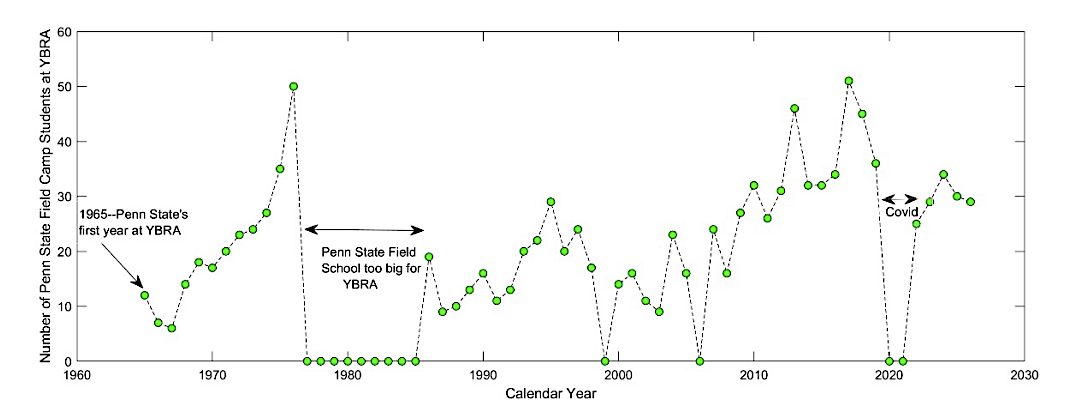
Figure 2. Number of Penn State geology/geoscience majors hosted by YBRA while attending Penn State field school. The numbers come from the Penn State Alumni Field Camp website: https://www.geosc.psu.edu/alumni-field-camp#1980- 23634 .
Photo courtesy of Slingerland
#GeologyFieldCamp #PennState #YBRA #EarthSciences #FieldworkTradition